Pipe Repairs
Pipe Repair & Repiping in Pueblo
Pipes fail in two ways: suddenly, which you notice immediately, and slowly, which you notice on the water bill or in the shower pressure years later. We handle both — and we’ll tell you straight when patching one more section has stopped being good value.
What we repair
- Leaking and burst pipes, including the frozen lines that split over winter and only show themselves on the thaw.
- Corroded and failing lines that have started leaking in more than one place.
- Pinhole leaks in copper, which tend to arrive as a set rather than one at a time.
- Failed joints and fittings, which is where most plastic pipe actually fails.
- Restricted lines that have silted or corroded closed enough to hurt pressure.
- Noisy pipes — water hammer and pipes knocking against framing.
- Partial and whole-house repipes, when replacing beats repairing.
If water is running right now and you cannot stop it, that is an emergency call — shut off the main first, then phone us. If you suspect a leak but cannot find it, start with leak detection; there is no sense opening anything up until we know where to open.
What your pipes are made of
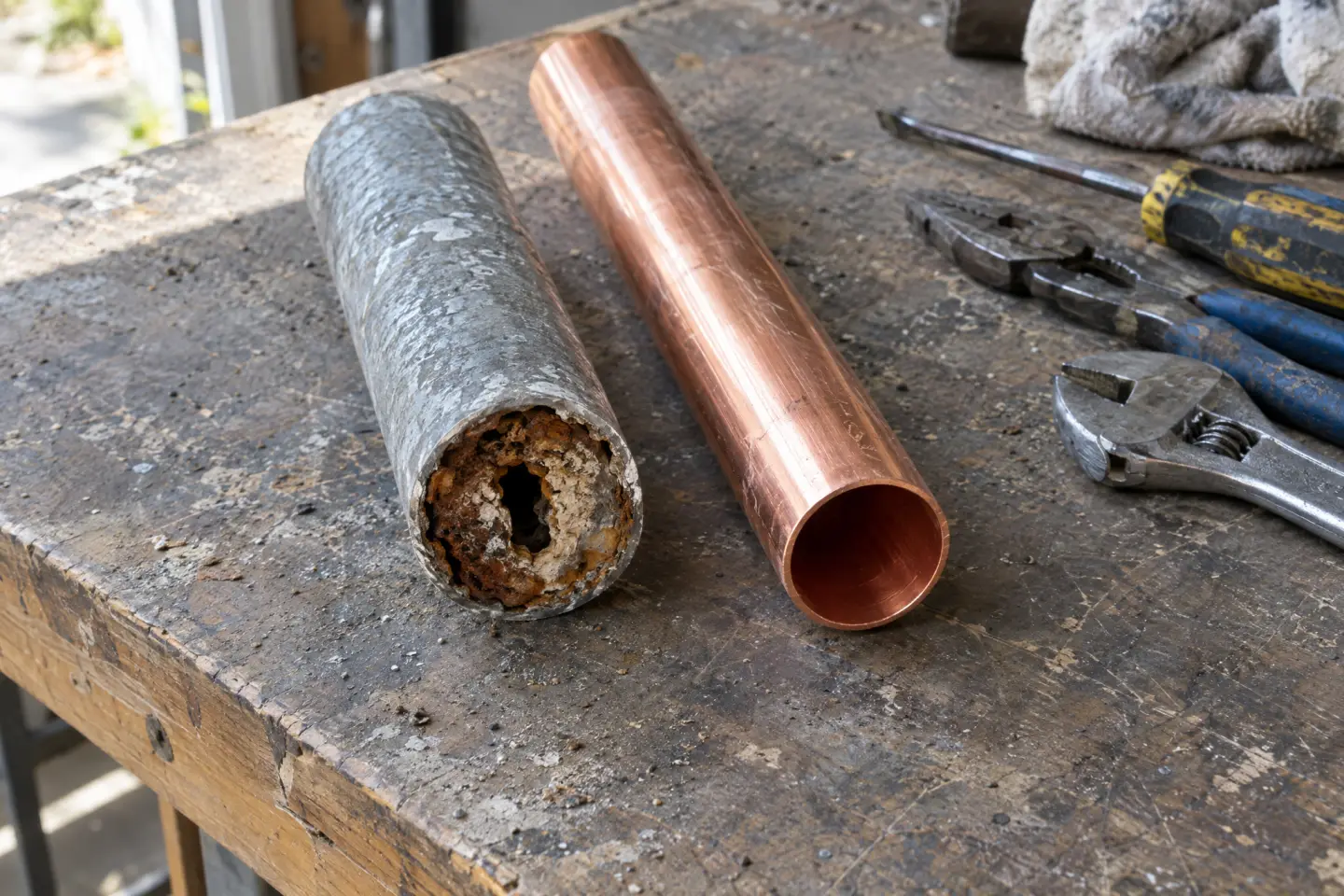
Knowing the material tells you most of what you need to know about what will fail and when. Older homes here very often have galvanized steel, which corrodes from the inside out. That is important, because it means the first symptom is not a leak — it is water pressure quietly dropping over years as the inside of the pipe narrows. By the time galvanized leaks, it has usually been strangling your flow for a long while.
Copper lasts well, though it can develop pinhole leaks with age. CPVC works but grows brittle. PEX is what most repipes use now, partly because it tolerates freezing better than rigid pipe, which matters in a Colorado winter.
The one to know about is polybutylene — dull gray plastic, installed roughly between the late 1970s and mid 1990s. It has a long record of failing at the fittings with little warning. If your home has it, it is worth planning a replacement on your schedule rather than discovering the problem on its.
Repair or repipe?
This is the question worth getting right, because it is where the money is. A single failure on otherwise sound pipe is a repair, straightforwardly. The calculation changes when the pipe itself is the problem rather than the spot that failed.
Signs that you are patching a losing system: leaks appearing in different places within a year or two, visible corrosion along the runs you can see, pressure that has fallen across the whole house rather than at one fixture, or discolored water when a tap has been sitting. At that point each repair buys less time than the last, and the repairs start adding up to the replacement anyway.
We will give you both prices and say which one we would choose, with the reasoning. Repiping is the bigger job and we would rather you chose it with the numbers in front of you than be talked into it — or be sold three more patches on a system that has finished.
Low water pressure
Pressure problems split neatly. One fixture that has gone weak is usually a blocked aerator, a partly closed stop valve, or a failing cartridge — small, cheap, quick. The whole house going weak is a supply-side question: a partly closed main valve, a failing pressure regulator, corrosion narrowing the lines, a hidden leak bleeding off pressure, or something on the municipal side.
Pressure that fell gradually over years usually points at the pipes themselves. Pressure that dropped suddenly points at a valve, a regulator or a leak, and sudden is the one worth calling about promptly.
Frozen pipes
Winter does most of the sudden damage around here, and it is largely preventable: disconnect hoses before the first freeze, insulate exposed runs in crawlspaces and garages, open cabinet doors on cold nights so warm air reaches pipes on exterior walls, and keep the heat on if you travel. The emergency page covers what to do if one has already frozen, including why an open flame is the wrong answer.
What to expect
We find the failure, explain what caused it, and price the work before going further. Where a repair means opening a wall, floor or ceiling, we keep the opening as small as the job allows and tell you up front what will need patching afterwards — plumbers generally restore the plumbing, not the drywall and paint, and it is better to know that at the quote than at the end.
Pipe work is covered by our 1-year guarantee on larger jobs, repipes included.
What it costs
Pipe repair is $120 per hour during regular hours. Emergency work outside those hours, when a line is failing and you need help right away, is $240 per hour. We quote most jobs before any work begins. On the rest, we explain what we find before going further. See the full rate table.
People Ask
Pipe questions
Why is my water pressure low?
Low water pressure can be caused by several issues, including:
- Mineral buildup inside pipes
- A partially closed shut-off valve
- Hidden leaks in your plumbing system
- Problems with the municipal water supply
- Aging or corroded pipes
If low pressure is affecting multiple fixtures in your home, a professional inspection can help identify the root cause and restore normal flow.
What are my water pipes made of, and does it matter?
It matters a great deal, because it tells you what is likely to fail and when. In homes around here you will usually find one of these:
- Galvanized steel — dull gray, magnetic, common in older homes. It corrodes from the inside, which narrows the bore and chokes your water pressure long before it leaks. Falling pressure throughout an older house is very often this.
- Copper — long-lasting and still a good material, though it can develop pinhole leaks with age or aggressive water.
- PEX — flexible plastic, usually red, blue or white. Modern, tolerates freezing far better than rigid pipe, and what most repipes use today.
- CPVC — rigid cream-colored plastic. Serviceable, but becomes brittle with age.
- Polybutylene — dull gray plastic, installed roughly between the late 1970s and mid 1990s. It has a poor reputation for failing at the fittings, often without warning. If you have it, it is worth planning a replacement rather than waiting.
Not sure which you have? Show us a photo of an exposed run and we can usually tell you straight away.
Why do my pipes bang or knock?
A bang when a tap or appliance shuts off is water hammer: moving water stopping abruptly and the shock travelling back through the pipe. It is most noticeable with washing machines and dishwashers, because their valves close fast.
It is worth sorting out rather than living with. The same shock that makes the noise also works on joints and fittings over time, and it is a genuine cause of leaks later on. Usually it comes down to failed or waterlogged arrestors, or pipes that are not properly secured and are knocking against framing — both fixable.
A steady knocking or ticking that follows hot water use is different and usually harmless: it is pipe expanding against a joist or strap as it warms.